Tuesday, July 5, 2011

Business Process Transformation (BPT ) - A Business Example

BUSINESS PROCESS TRANSFORMATION
“An organizational make-over”
“Transformation is new, and it has to be done.”

â         What is a Business Process ?
         Step By Step Work Activity
>>        It has a Beginning & End
>>     Clearly defined INPUT & OUTPUT
â         BPT Synonyms:
>>   Business Process Redesign,
>> Business Process Re-Engineering
>> Process innovation,
                    >> Business reinvention and so on

â         Why BPT?
           >> Business Transformation is a Change Management strategy  aimed to align People,    Process and Technology more closely with business strategy and vision of the Company.
           >>In turn this helps to support and innovate new business strategies

A BPT Example in Banking
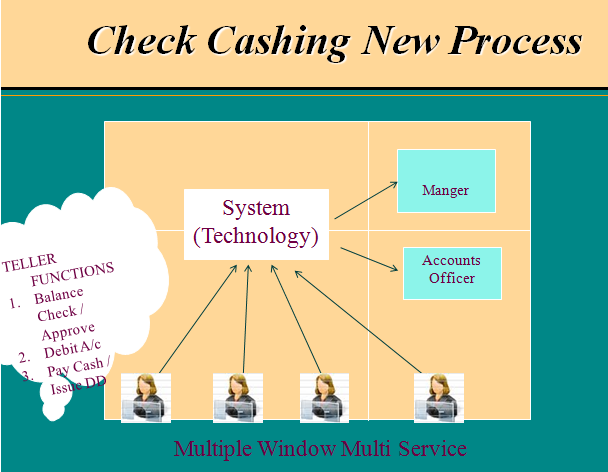
Cashing a Check


Disadvantages of Legacy Processes Involved

>> 1. One Clerk for each function

e.g. SB A/C, Current A/C, DD etc

 >> 2.  Load may not be Balanced  among clerks

>> 3. Lengthy & Redundant Process

>> 4. Poor Customer Service (Important Stake holder )

â         Why?
>>   Concentrate on Functions rather than end-to-end process (Function Vs Process)
>> Lack of Authority (A Clerk cannot  approve a check  for payment)
>>   Lack of  information (Because of Manual Registers)
<<>> Need of Technology : Right information to right people at right time

â         Advantages
>> Length of Process is considerably reduced
>> Efficient
>> Better Customer Satisfaction
â        Any Further Improvement Possible?
WHY Come to Bank at ALL?

Tuesday, March 29, 2011

Technical Equation of Life


Wheel of Life


Give points between 0 and 10 (10=ideal) scale for your satisfaction level for each of the 8 areas of your life and draw a graph connecting. Center of the circle is zero and outermost is 10.
How does the shape show?
Is it a smooth figure?

Now think where you can improve with what correction? (e.g developing more friendships, spending more time at home etc)
Draw another wheel with the correction.

Personality in Audulthood.
Is there development in Adulthood?
More marked shift in personality occurs in adulthood and not in adolescence.
E,g. When adults make profound role shift (in marriage, a new job etc)
These are universal development sequence in mastery styles
These styles are unique to each adult which are the basis for experiencing various events in life
Universal changes in health, appearance and intellectual functioning have parallel in personality.

Patterns in Men
   Young men  - Active mastery
    Middle ages - Passive mastery
    Old - Magical mastery (distorted from reality -> It is OK, God will take care attitude)
Women
    Young - Passive
     Old - Active
Lifespan cognition Research
Processing Efficiency - Show age related decrease
Knowledge - greater when relevant to any task. They predominantly work in one's thought process

Thinking is the application of reasoning and other cognitive processes to one's available knowledge to achieve some goal.

Inner voice & Personal brilliance
-To avoid becoming victim of one's success
-Deal with recognising and strengthening one's inner voice and the ability to understand the inner voice of others
-Fundamental concepts includes the use of the four catalysts of personal brilliance - Awareness, Curiosity, Focus, Iniative
-Approaches can be several depending on the competeness of the professional
-Holistic intervention modules
-Using biological, psychological, social, spiritual dimension of an individual

Wishing you life events where you cherish the benefits of solving life's technical equation.

The value of experience is not seeing MUCH, but seeing WISELY


Effective Leadership

Who You Are?
    Education
    Experience
    Network (Connection with people)
    Networth (Money)
    Family
    Your body
This makes your Platform.
What you do with it is your PURPOSE
Platform is a spring board
Purpose leads to the impact you make over time.

Platform Vs. Purpose
 
 
Key drivers

             
Consumption
A need to have Eduaction
High life style
Consumption is his success
 
Low Platform / High purpose(Satisfied being a Teacher)
Altruism: desire to do good
E.g. Early stage companies

Sense of Legacy
To leave something behind (a legacy)
is the primary sense of a leader

High platform / High performance
Needs feelings for people many times away from you (down the heirarchy or un-connected)
Must have long view of time (takes a life time to make a difference)
Not fazed by failure, willing to pay personal price
Driven by sense of legacy (builds an emotional infrastructure)
Physical infrastructure just gives your presence, intellectual infrastructure matters
So Focus on emotional infrastructure

Emitional Infrastructure Companies
Leadership proximity
Rich communication lines (multiple network , not just boss to subordinate)
Vision, values
Use of Technology

Monday, December 6, 2010

Wikileaks, Radia Tapes and What not!!!

Nations are Jittery as hundreds of governmental secret documents and being published by WikiLeaks every day. Indeed Governments are stripped naked!!!
In India Secret conversation between Public Relation Consultant and MNC bosses to influence Government policies are heard by every one through stealed voice tapes!
Secrets are no more Secrets.
Time is over when You can do things secretly.
Bible says "
"What you have said in the dark will be heard in the daylight, and what you have whispered in the ear in the inner rooms will be proclaimed from the roofs"

Above all Nothing ia secret before God, He sees you totally.

Tuesday, August 31, 2010

BPR - Business Process Re-Engineering Principle

1. "If It's Not Broken, Don't Fix It"

2. "It It is Broken, Make Sure You Understand the Process Before You Try to Fix It"

3. "When You Fix It, Make Sure That There Is Value in Fixing It"

4. "After You Fix It, Make Sure You Don't Have Any Leftover Parts"

Thursday, July 29, 2010

BP Oil SLick/Gulf of Mexico - Americas Toilet Bowl

When Nazia Dardar looks at the seemingly endless lake of water behind her stilted bayou home, the 76-year-old sees what once was a farm.

Cows roamed there, she says, back when the lake was land.

"C'est le jour et la nuit," she says in French, the most common language down here on the farthest and swampiest reaches of the Mississippi River delta. "It's day and night."

Perhaps nowhere is the protracted death of the Gulf Coast more apparent than in Pointe-Aux-Chenes, Louisiana, and other indigenous bayou communities where, decades before the BP oil disaster, the marsh started disintegrating and environmental problems washed in from as far away as North Dakota and New York.

The Gulf of Mexico became, in effect, the United States' toilet bowl -- known for its seasonal "dead zones," high erosion rates, dirty industry, ingrained poverty and, now, for the biggest oil disaster in the history of the country. Compare that legacy on the Gulf Coast with the East Coast, with its wealth, and the West, with its more-sterling record of environmental stewardship.

Since the massive oil disaster began nearly 100 days ago, some American Indian communities on the coast here for centuries, including Pointe-Aux-Chenes, have begun grappling with the idea that they may need to retreat from the oil-sullied marshes.

Some fear cultural extinction.

READ FURTHER ON CNN http://edition.cnn.com/2010/US/07/27/gulf.history.environment.toilet/index.html#fbid=mZVWtInEJRN

Monday, June 21, 2010

Currency without a Head

On my desk as I write are two banknotes — £20 sterling and 20 euros. On the former is a picture of the Bank of England, the signature of Andrew Bailey, its Chief Cashier, and the head of the Queen. The euro note also carries a signature. It is illegible but, since it comes under the letters “ECB” (European Central Bank), perhaps it is that of Jean-Claude Trichet, the bank’s President.


There is no picture of a financial location, and nobody’s head. Instead, one side of the euro note depicts a couple of gothic windows, and the other, beside the map of Europe, a fine old bridge. It is no accident that the note carries no head. It is because the single European currency came into being without a single European economic government and without political union. It therefore has no ultimate authority. When the euro was launched at the end of the last century, both its friends and its foes predicted that this lack of authority could not last. At some point more power would have to be put behind it, or it would collapse.

We have now got close to that point. Euro notes carry the word “euro” in Roman lettering, of course, but also, in deference to one EU member, print it in Greek characters. It is Greece’s sovereign debt crisis which began the current agonies. Will those Greek letters have to come off the notes? The same crisis threatens Portugal and now — much more serious — Spain. If it reaches Italy, the country with the third biggest public debt in the world, the game would appear to be over. The fine old bridge would be blown up. So far, European leaders have tried to deal with this spreading disaster by ruses. Existing European treaties ban bail-outs of member states. So the “European Stabilisation Mechanism”, recently set up precisely to provide these illegal bail-outs, does so under Article 122.2 of the Lisbon Treaty. This article gives emergency assistance to a member state “threatened with severe difficulties caused by natural disasters or exceptional circumstances beyond its control”.

Natural disasters! We are experiencing a totally unnatural disaster, one brought about by the artificial structure of the European project. Exceptional circumstances beyond its control! It was this system that every eurozone member state proudly (though usually without asking their electorates) voted for. The situation is not funny for the people of Greece, Portugal, Spain, and so on, because their governments have run up dreadful public debts while sacrificing their power to devalue to become competitive. They cannot cut their exchange rate, so they must cut wages and jobs. Unemployment in Spain is already 20 per cent — and 40 per cent among young people. It is not funny for Germany, either. German banks are overcommitted in the southern countries now afflicted. The German people are fed up with paying for the profligacy of their poorer neighbours and furious at the suggestion that the only solution is that they should pay even more.

What will actually happen? Among people who follow bond markets and consider financial realities, certainty about the European currency has evaporated. Many think that the £750 billion “shock and awe” fund promised by the EU and the IMF is a bluff. The unthinkable idea that the eurozone might break up is now being thought. And the version of break up gathering ground in people’s minds is not that the poor, indebted countries would fall out — they are prostrate and helpless — but that Germany would rise up like Gulliver, snap the insubstantial euro-ropes tied round its body, and walk away. Offering a foretaste, a German stockmarket website called Borsenews has now started pricing shares in Deutschmarks as well as euros.

On the other hand, what makes economic sense also looks politically impossible. Angela Merkel, the German Chancellor, promised to put her foot down and punish the Greeks three months ago, only to give in and launch the rescue a few weeks later, a delay that dramatically increased her country's bill. The German political class has spent 60 years recovering respectability through “Europe”. It simply cannot face losing it.

But there is no alternative vision in the eurozone. The leaders remain determined to have no Plan B. So what we are about to get is the missing bit of Plan A. They will try to create a sort of European Treasury with centralised economic and fiscal policy — the imposition, in short, of undemocratic European economic government.

Again and again in politics, great schemes don’t work — Soviet Communism, for example, and now the euro. Rational people tend to conclude that, because a scheme doesn't work, it will quickly stop. Unfortunately, rational people are wrong. Bad political schemes are usually given up only when they have been tested literally to destruction. It would be much better for Europe if the euro had never happened, and I long for it somehow to fade away, but the process of destruction will be horrendous, and it is only just beginning.

© The Daily Telegraph